|
ValueSet graphic display options allow you to independently format how each ValueSet is displayed as numbers and graphs of numbers.
About ValueSets
There are 5 types of ValueSets. Which one you chose depends on how numbers will be entered. For example, for ValueSet type 1, values are for the entire schedule while ValueSet type 2 requires entry of values for each task. The types of ValueSets are shown next.
Think about how the numbers to be graphed will be organized. Is there a single set of numbers which apply to the entire schedule (type 1), a set of numbers by time period for each task row (type 2), a single number for each task row (type 3), a number for each symbol (type 4), or will the ValueSet be a total of other ValueSets (type 5).
Create a ValueSet:
-
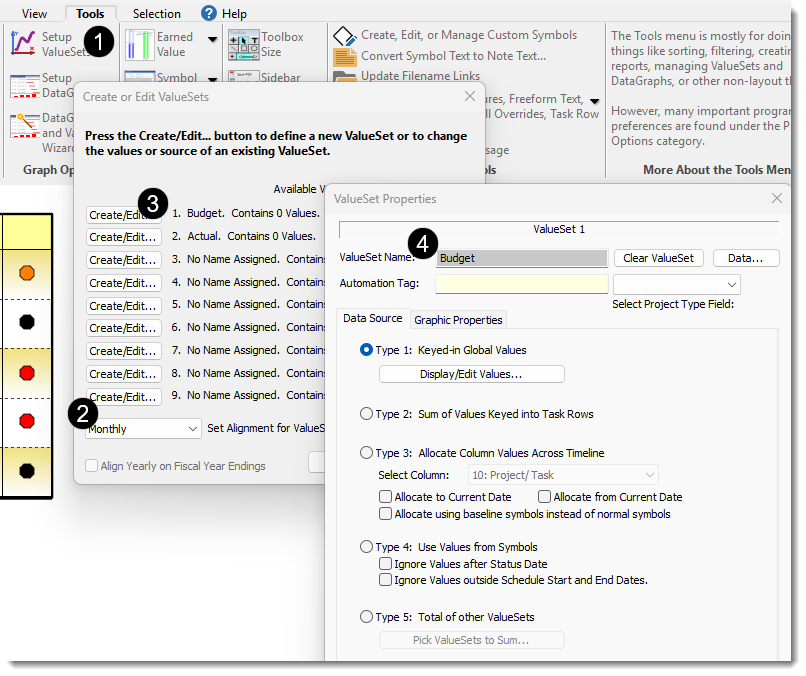
Choose Tools | Graph Options | Set Up ValueSets.
-
For Set Alignment For ValueSets, choose either Daily, Weekly, Monthly, Quarterly, or Yearly.
-
Choose the first available Create/Edit button to set up the new ValueSet.
-
Enter a ValueSet Name which is meaningful to you. This name will appear in the DataGraph legend next to its line/bar graph color.
ValueSet type 1: Keyed-in global values
In the Type 1 ValueSet, the values are entered by time period for the whole schedule. See: Tutorial Lesson 11 - Introduction too ValueSets and DataGraphs and Tutorial Lesson 12 - More ValueSets and DataGraphs
Create a Type 1 ValueSet:
-
Follow the instructions for Create a ValueSet (above.) Choose  Type 1: Keyed-in Global Values. Type 1: Keyed-in Global Values.
-
Click the Display/Edit Values button.
-
Enter values for each time period and then OK.
- The date range for the value entries are generated automatically based on the schedule’s start and end date and the option you have chosen for Alignment (Step 2 above).
- Optionally, import values which have been copied to the clipboard.
- Optionally, copy the existing values and dates to the clipboard. You can then paste those values into another application.
ValueSet type 2: Sum of values keyed into task rows
In the Type 2 ValueSet, you enter a set of values by time period for selected tasks. The numbers that appear on the DataGraph represent the sum of these values for each time period. See: Tutorial Lesson 11 - Introduction too ValueSets and DataGraphs and Tutorial Lesson 12 - More ValueSets and DataGraphs
Create a Type 2 ValueSet:
-
Choose Tools | Graph Options | Set Up ValueSets.
-
For Set Alignment For ValueSets, choose either Daily, Weekly, Monthly, Quarterly, or Yearly.
-
Choose the first available Create/Edit button to set up the new ValueSet.
-
Enter a ValueSet Name which is meaningful to you. This name will appear in the DataGraph legend next to its line/bar graph color.
-
Choose Type 2: Sum of Values Keyed into Task Rows.
-
Choose the Graphic Properties tab. Select Graph Properties.
-
Choose OK. Create or edit other ValueSets.
-
Choose OK to return to the schedule.
ValueSet type 3: Allocate column values across timeline
In the Type 3 ValueSet, values are entered in a column. The values entered are then spread across each task's time span. The numbers that appear on the DataGraph represent the sum of these values for each time period. For example, if Task 1's column value is $100 and Task 1 has a 5 day duration, then $20 will be allocated to each day. See: Tutorial Lesson 11 - Introduction too ValueSets and DataGraphs and Tutorial Lesson 12 - More ValueSets and DataGraphs
Create a Type 3 ValueSet:
-
Add a Values SmartColumn to the schedule which contains the values you want to spread across each task's duration.
-
Choose Tools | Graph Options | Set Up ValueSets.
-
For Set Alignment For ValueSets, choose either Daily, Weekly, Monthly, Quarterly, or Yearly.
-
Choose the first available Create/Edit button to set up the new ValueSet.
-
Enter a ValueSet Name which is meaningful to you. This name will appear in the DataGraph legend next to its line/bar graph color.
-
Choose Type 3: Allocate Column Values Across Timeline.
-
Select Column: Choose the column whose values will be spread across the task bars.
-
Allocate to Current Date: Values will be spread evenly from the task's start date to the current date.
-
Allocate from Current Date: Values will be spread evenly from the current date to the task's end date.
-
Allocate using baseline symbols: Values will be allocated to task bars with baseline start and end symbols, instead of normal start and end symbols.
Example 1: Column values allocated to normal symbols, only
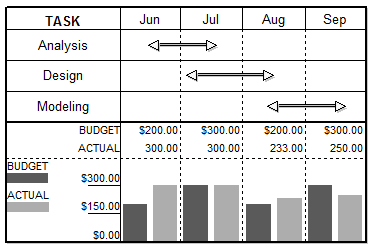
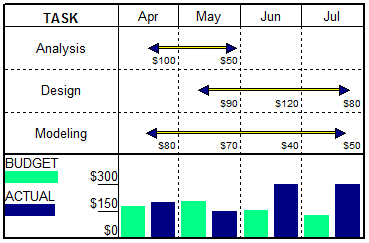
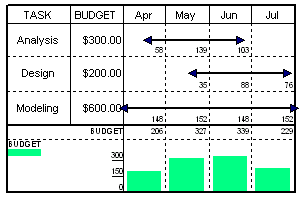
For example, in the "Analysis" task, the $300 is distributed over April, May and June. The amount for each month is based upon the total number of days in that month that are included in the time span. (Notice that the value for May is larger since it is a full month.)
The distributed values for all tasks are added up by month. The monthly totals are then displayed and graphed in the DataGraph at the bottom of the schedule.
Example 2: Column values allocated to baseline and normal symbols
Values can be allocated to baseline task bars or normal task bars. For example, budget can be associated with baseline task bars (representing the original plan), while costs can be associated with the normal task bars (representing the current plan).
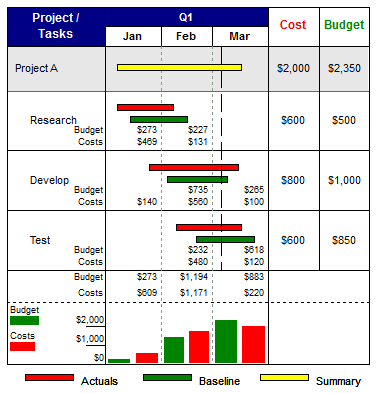
In the example below, the "Costs" ValueSet takes the "Cost" Values SmartColumn numbers and allocates them across the red task bars which use normal start and finish symbols. Cost values are also allocated only up to the current date, since costs after the current date do not exist. The "Budget" ValueSet takes the "Budget" Values SmartColumn numbers and allocates them across the green task bars which use baseline start and finish symbols.
The "Research" activity has a Cost value of $600. That amount is spread evenly across Research's red task bar, representing the actual start and end dates. "Research" has a Budget value of $500. That amount is spread evenly across Research's green task bar, representing the baseline start and end dates.
The distributed values for all tasks are added up by month. The monthly totals are then displayed and graphed in the DataGraph at the bottom of the schedule. In the example, the values are displayed as non-cumulative and graphed as cumulative.
ValueSet type 4: Use values from symbols
In the Type 4 ValueSet, values are entered for symbols on the schedule. Each symbol can contain values for any or all of the nine possible ValueSets. Thus, a symbol can contain a budget value, cost value, manhours value and more. When the symbol is moved, the values move with the symbol. The numbers that appear on the DataGraph represent the sum of these values for each time period. See: Tutorial Lesson 11 - Introduction too ValueSets and DataGraphs and Tutorial Lesson 12 - More ValueSets and DataGraphs
Create a Type 4 ValueSet:
-
Choose Tools | Graph Options | Set Up ValueSets.
-
For Set Alignment For ValueSets, choose either Daily, Weekly, Monthly, Quarterly, or Yearly.
-
Choose the first available Create/Edit button to set up the new ValueSet.
-
Enter a ValueSet Name which is meaningful to you. This name will appear in the DataGraph legend next to its line/bar graph color.
-
Choose Type 4: Use Values from Symbols.
-
-
Ignore Values after Status Date: Only the values attached to symbols before the status date will be displayed and graphed.
-
Ignore Values outside Schedule Start and End Dates: Only the values attached to symbols within the schedule start and end date range will be displayed and graphed.
-
Note that symbol values can only be entered after the ValueSet has been created.
-
Choose OK. Create or edit other ValueSets.
-
Choose OK to return to the schedule.
Enter values for symbols on the schedule:
Values for the Type 2 ValueSet should be entered at the lowest activity level.
-
Click  (the toolbox Arrow tool.) (the toolbox Arrow tool.)
-
Click once on the symbol. This will display the Selection menu.
-
Choose the ValueSets tab.
-
Enter values for any available ValueSets. Press the  apply button. apply button.
-
Repeat for other symbols.
Example: Type 4 ValueSet
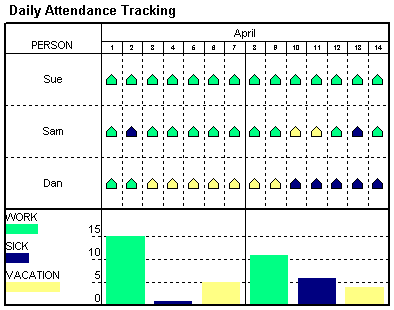
The example below has three Type 4 ValueSets. The example shows the daily attendance for three employees (Sue, Sam and Dan). The green symbols have a value of 1 entered for the "Work" ValueSet. The blue symbols have a value of 1 entered for the "Sick" ValueSet and the yellow symbols have a value of 1 entered for the "Vacation" ValueSet. This schedule has ValueSet alignment set to weekly, so just a weekly total for each ValueSet is displayed in the DataGraph.
Set a default value for a type 4 ValueSet
-
Double-click a symbol in the toolbox.
-
Click the ValueSet tab.
-
The ValueSet names will be listed. Enter a default value for one or more ValueSets.
 If you have a situation where each symbol will have the same values, set a default value in the toolbox. The default value will be used whenever that symbol is added. Double-click the symbol in the toolbox and choose ValueSet Defaults. If you have a situation where each symbol will have the same values, set a default value in the toolbox. The default value will be used whenever that symbol is added. Double-click the symbol in the toolbox and choose ValueSet Defaults.
ValueSet type 5: Total of other ValueSets
Type 5 ValueSets sum the values from other ValueSets See: Tutorial Lesson 11 - Introduction too ValueSets and DataGraphs and Tutorial Lesson 12 - More ValueSets and DataGraphs

Create a Type 5 ValueSet:
-
Choose Tools | Graph Options | Set Up ValueSets.
-
For Set Alignment For ValueSets, choose either Daily, Weekly, Monthly, Quarterly, or Yearly.
-
Choose the first available Create/Edit button to set up the new ValueSet.
-
Enter a ValueSet Name which is meaningful to you. This name will appear in the DataGraph legend next to its line/bar graph color.
-
Choose Type 5: Total of other ValueSets.
-
Click the button Pick ValueSets to Sum.
-
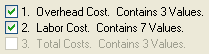
Check the ValueSets to sum and then OK.
Example: Type 5 ValueSet
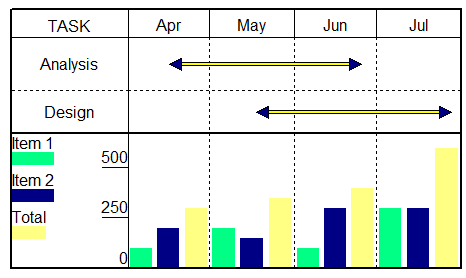
In this example, there are two Type 1 ValueSets: "Item 1" and "Item 2." There is one Type 5 ValueSet: "Total" "Total" sums the values from the other two ValueSets and graphs the sum.
Notes:
-
Type 5 ValueSets will total all values within and outside the visible date range, when those values are contained in Type 1 or Type 4 ValueSets.
-
Type 5 ValueSets should only include Type 2 ValueSet data if all Type 2 ValueSet data is in the visible date range.
-
Type 5 ValueSets should only include Type 3 ValueSet data if all Type 3 ValueSet data is in the visible date range.
-
To edit an existing ValueSet or add another ValueSet, right-click the DataGraph and choose Create or Edit ValueSets.
-
Set the currency display format under Format | International | International, Number, and Currency Settings.
-
DataGraphs display either bar or line graphs. If you want to display bars instead of lines, set this by changing the DataGraph properties.
To edit an existing ValueSet or add another ValueSet, right-click the DataGraph and choose Create or Edit ValueSets. Set the currency display format under Format | International | International, Number, and Currency Settings.
ValueSet Properties
|
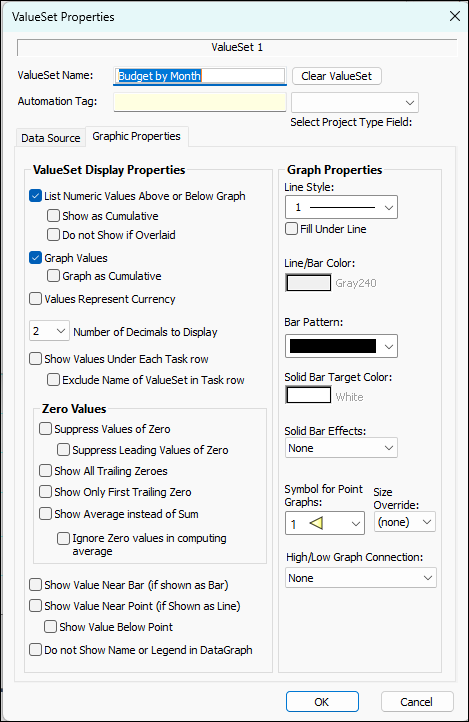
ValueSet Display and Graph Properties:
 List Numeric Values Above Graph: Values appear above DataGraph. When un-checked no values are listed. List Numeric Values Above Graph: Values appear above DataGraph. When un-checked no values are listed.
Show as Cumulative: Values appear above DataGraph as cumulative values.
Graph Values: Values are converted to line or bar graphs
Graph as Cumulative: Cumulative values are converted to line or bar graphs.
Values Represent Currency: Add currency symbol to values.
Show Values Under Each Task Row: For Type 2 and 3 ValueSets, only. Display values on the task row and within the appropriate time periods. For Type 4 ValueSets, substitutable symbol text can be used. (e.g.: &vs1 for ValueSet 1)
Exclude Name of ValueSet in Task Row: For Type 2 and 3 ValueSets, only. Hide the name of the ValueSet which will otherwise display in the column area, in line with its value on the task row.
Suppress Values of Zero: To not display values of 0 (zero) above/below the DataGraph or on task row ValueSet value displays.
Show Average instead of Sum: Normally, ValueSet values are totaled by time period, then displayed above the graph and graphed as summed values. This option changes that computation to an average of values.
Ignore Zero values when computing average: Does not consider ValueSet values of zero when computing average.
Graph Properties
Line Style: For line graphs in the DataGraph, choose a thin line, dotted line, dashed line or thicker line.
Line/Bar Color: Choose a line color or bar fill color.
Bar Pattern: For bar graphs in the DataGraph, choose a pattern which fills each bar. Marbled patterns are full-colored bitmaps which will ignore any foreground or background color settings. Use of these increases the size of printer files and metafiles, especially on high-resolution printers.
Solid Bar Target Color: For the solid Bar Pattern, choose a Target Color for fading from the Line/Bar Color to this Target Color. For other bar patterns, the Target Color fills the white area shown in the bar pattern sample.
Solid Bar Effect: For the solid Bar Pattern only, choose a gradient fill pattern for fading from the Line/Bar Color to this Target Color.
|
Export ValueSet values to clipboard
|
Values from Type 1 and Type 2 ValueSets can be exported to the clipboard, then pasted into another program. Include the values only, or the values and dates associated with the values.
Export Type 1 ValueSet values to the clipboard:
-
In Milestones Professional, choose Tools | Graph Options | Set Up ValueSets.
-
Click the Create/Edit button for the appropriate ValueSet.
-
Click Display/Edit Values for the Type 1 ValueSet.
-
Click Copy Values to Clipboard or Copy Values and Dates to Clipboard.
-
Copy Values to Clipboard: Numbers from the Value entry slots are copied to the clipboard.
-
Copy Values and Dates to Clipboard: Numbers from the Value entry slots and dates from the From and To columns are copied to the clipboard.
-
In the other application, paste the values from the clipboard.
Export Type 2 ValueSet values to the clipboard:
-
In Milestones Professional, right-click the task row whose Type 2 ValueSet values, or values and associated dates are to be copied to the clipboard.
-
Choose Edit ValueSet.
-
Click the Edit button for the appropriate ValueSet.
-
Choose Task Row Only (values for the selected task only) or Chart Total (values for all task rows).
-
Click Copy Values to Clipboard or Copy Values and Dates to Clipboard.
-
Copy Values to Clipboard: Numbers from the Value entry slots are copied to the clipboard.
-
Copy Values and Dates to Clipboard: Numbers from the Value entry slots and dates from the From and To columns are copied to the clipboard.
-
In the other application, paste the values from the clipboard.
|
ValueSets - Display values below individual task rows
Type 2, 3 or 4 ValueSet values can be displayed below individual task rows, along with the name of the ValueSet in the column area. See: Tutorial Lesson 11 - Introduction too ValueSets and DataGraphs and Tutorial Lesson 12 - More ValueSets and DataGraphs
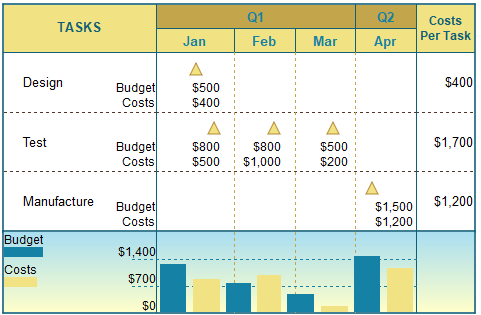
Display a ValueSet’s values below each task row
-
Choose Tools | Graph Options | Set Up ValueSets.
-
Click the Create/Edit button for the ValueSet.
-
Click the Graphic Properties tab.
-
Show Values Under Each Task Row.
-
or  Exclude Name of ValueSet in Task Row. Exclude Name of ValueSet in Task Row.
The font size for the values and text is set under Format | Default Text | Symbol Text.
To edit an existing ValueSet or add another ValueSet, right-click the DataGraph and choose Create or Edit ValueSets. DataGraphs display either bar or line graphs. If you want to display bars instead of lines, set this by changing the DataGraph properties.
|
